
How to Make Cabochon Jewelry From Acrylic Pour Skins
When I first started making jewelry from my acrylic pour skins, my cabochons were pretty bad. You could see streaks of glue under the glass, folds in the skin, and rough edges where I never trimmed it.
So I hosted two paint pouring parties, collected a couple dozen skins, and made about two dozen new cabochons. I tested different glues, cutting tools, and assembly orders so you don’t have to.
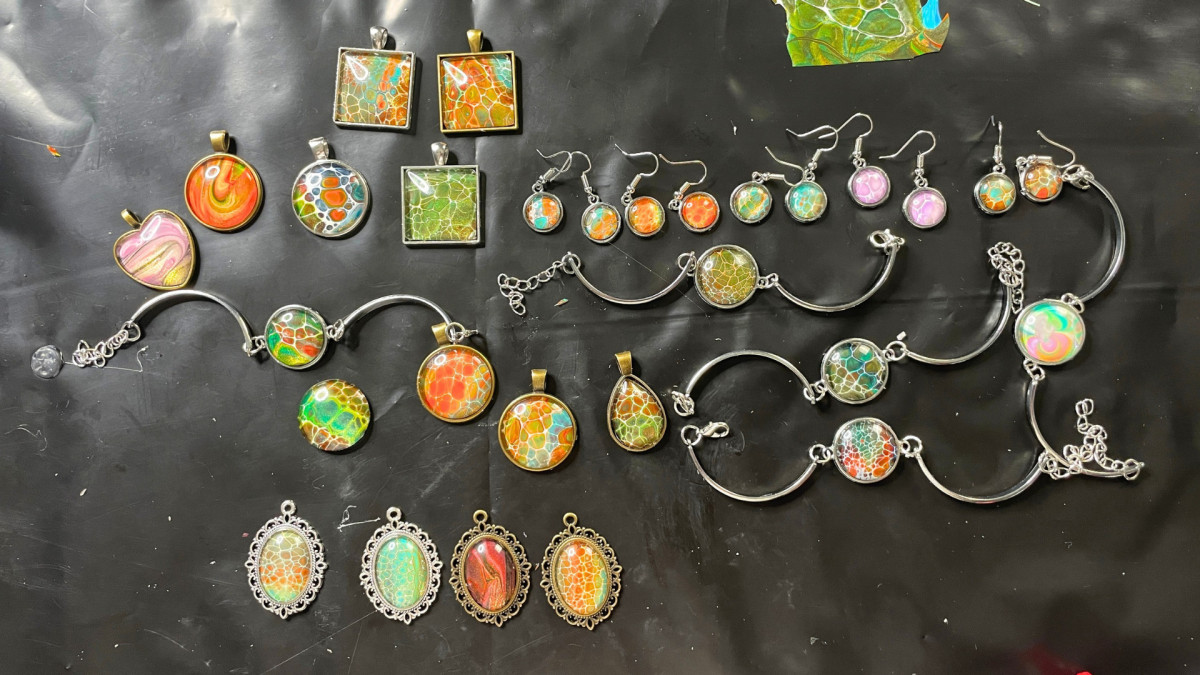
So what is the best way to make pour skin cabochons?
Glue the glass directly to the skin with Diamond Glaze, cut around it with good scissors, then glue that into the metal tray with E6000. However, the order and the amount of pressure matter more than you would think.
Gather Your Supplies (1)
- Acrylic pour skins – I pour on 2 mil black polyethylene sheeting. Acrylic doesn’t bond to it, so skins peel right off.
- Metal bezel trays with matching glass cabochons – I used round, square, oval, heart, and earring sizes that I purchased on Amazon.
- Diamond Glaze – for gluing the glass to the skin
- E6000 – for gluing the finished piece into the metal tray.
- A good pair of small scissors – my cheap kitchen scissors didn’t work nearly as well.
- Razor blade – for scraping dried Diamond Glaze off the glass at the end. My wife has this kit we use for all sorts of similar things too – Travel Carvers Kit
Peel your skins slowly and at a low angle. Pulling fast or straight up stretches the skin, and that is where folds come from. Don’t stack loose skins, either. They can fuse into one big chunk.
If I find a skin I like but I am not making jewelry soon, I store it in a plastic page protector in a 3-ring binder. A sheet of parchment paper inside each page lets me fit two skins per page, one on each side.
Pick Your Spot (2)
Slide the bare glass around the skin before you glue anything. The dome magnifies, so a plain-looking spot can look great under glass.
This is the biggest reason to glue the glass straight to the skin. You get to choose exactly what ends up in your pendant.
Which colors sell is very subjective. I like pieces with variation, more than one color, and effects like cells. However, know your market and make what your buyers want to wear.
What Glue Holds Glass to a Pour Skin? (3)
Diamond Glaze. It dries crystal clear and holds. Tacky glue looks just as good, but the glass peels right off.
Put a few drops of Diamond Glaze on the flat back of the glass and set it on your spot. Press only until the bubbles are gone.
Don’t use too much as it will squirt out the sides and making cutting the skin out more difficult. It also takes some scraping to get excess off the glass once dried.
Why are there shiny spots under my cabochon glass?
Those spots that look like holographic flakes are places where the glaze separated from the glass. The usual cause is pressing too hard.
This surprised me. Pressing harder feels like it should help, but it doesn’t. Too much pressure pushes the glaze out the sides, and as it settles back it can separate.
Make sure the surface you are pressing on is flat and that the skin is also flat. If you have layers of skins that aren’t flat it won’t bond properly to the glue and you’ll get the holographic spots.
The good news is that Diamond Glaze is crystal clear the moment you press it. Anywhere that isn’t clear is a bubble or a spot that didn’t stick, so you can fix it right away.
Wipe off any glaze that squeezes out while it is still wet. Dried Diamond Glaze is much harder to cut than the skin. Then let it dry for 24 hours. Mine dried super clear and shiny, even on plastic.
What Is the Best Way to Cut Pour Skins for Cabochons? (4)
Glue the glass on first, then cut around it with good scissors. The glass becomes your template.
Go slow and take lots of small snips.
Don’t scrape the scissors along the bottom of the glass. That will pull the skin right off. Leave any dried glaze on the glass for now, too. If you fiddle with it at this stage, you can pull the skin loose.
Dry Fit (5)
Set the glass and skin in the metal tray before gluing. Make sure it is turned the way you want. Once E6000 grabs after 15 or 20 minutes, you are not moving it.
Glue It Into the Tray (6)
Put a small dab of E6000 in the center of the tray and press the piece in. Using too much was my only real problem with it.
E6000 comes out like stringy putty and makes little spiderwebs as you pull the tube away. Don’t fight it. Clean the strings off afterward. They rub right off the glass and metal with your finger.
How long does E6000 take to cure?
E6000 is still a little flexible after one day and rock hard after 48 hours. Wait the full two days before anyone wears it. I didn’t notice much smell, but if you are sensitive to fumes, work somewhere with good airflow.
When Should You Scrape Off Dried Diamond Glaze? (7)
Once the E6000 has cured, scrape off any dried Diamond Glaze with a razor blade or anything a little harder than your finger. Don’t do this before the E6000 is hard. The skin needs to be locked in place so it won’t pull off the glass.
Can You Make Cabochons From Wet Paint Before It Becomes a Skin?
Yes, by dipping the glass in wet paint. If you are already pouring, dip the flat back of the cabochon into the wet paint right after your pour. The paint sticks to the glass as it dries, so you skip the Diamond Glaze and the cutting. You still need E6000 to glue it into the metal tray.
A friend of mine has a clever setup for this:
- Hot glue a golf tee to the top (domed side) of each cabochon as a handle.
- Dip the flat back into the wet paint.
- Push the point of the tee into a block of hard foam, so the cabochon dries with the wet paint facing up.
Don’t press hard. A light dip grabs the look of the paint right where it touches. Pressing pushes the paint around and smears the pattern.
Once the paint is fully dry, remove the golf tee and glue the cabochon into a tray with E6000, the same as step 6. The trade-off is planning. You have to dip while the paint is wet, while skins wait in a binder until you are ready.
What Didn’t Work
Here is everything I tried that I don’t recommend, so you can skip it.
| What I tried | What happened |
|---|---|
| Tacky glue between glass and skin | A little opaque while drying, then clear. It looked great, but the glass peeled right off. |
| Gluing the skin into the tray first, then the glass on top | Same glues, different order. Every piece had holographic spots where the glue didn’t stick. Clamping overnight fixed some, not all. Using a clamp after gluing may help reduce these spots |
| Cutting the skin out before gluing | Worked OK, but my edges didn’t always come out right. |
| 1″ circle hole punch | Perfect cuts, but it only reaches near the edge of a skin. You can’t pick a spot in the middle without cutting in to your larger skins. |
| Box knife | Needs a brand-new blade and was hard to steer around ovals, hearts, and rounded corners. I have big hands, so that could be me. A craft knife might work better. I haven’t tested it yet. |
Final Thoughts
If your first cabochons don’t turn out, you are not alone. Mine were bad too. Write down what went wrong, and the next batch will be better.
Have leftover skins after this? Check out my video on turning pour skins into bookmarks.